
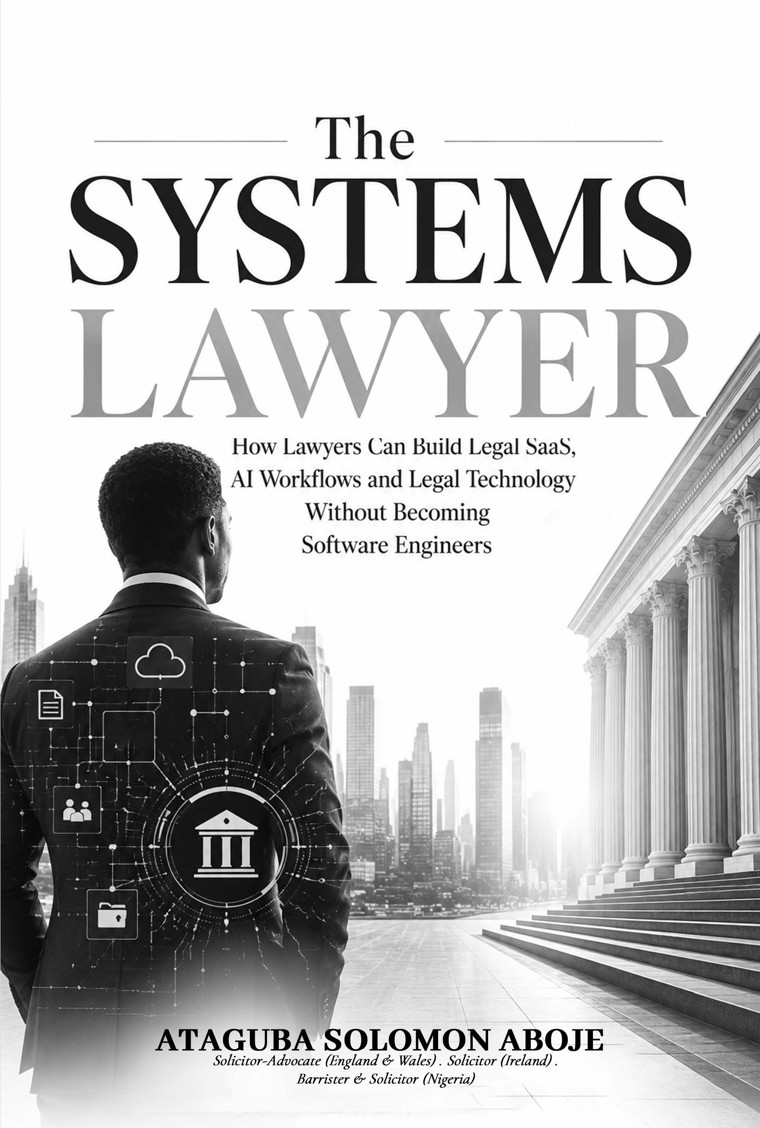
The book
The Systems Lawyer
How lawyers can build legal SaaS, AI workflows and legal technology — without becoming software engineers.
By Ataguba Solomon Aboje
For lawyers shaping technology
Your legal knowledge.
A system you can supervise.
Design with professional judgement at the centre.
- 01Describe the task.
- 02Locate the risk.
- 03Plan the review.
An idea from the book
Verification,
not generation.
Generative tools can state falsehoods fluently. Build the check into the design.
- —Show the source.
- —Preserve uncertainty.
- —Support the reviewer.
The Legal SaaS Stack
Five layers between a legal problem
and a tool worthy of the court’s trust.
- 01DataWhat the system knows — statutes, cases, rules, precedents and matter information. Garbage in, liability out.
- 02RetrievalHow it finds the relevant part of what it knows — and knows what it missed.
- 03ReasoningHow it works over what it has found.
- 04DraftingHow it expresses a result.
- 05ReviewHow a human checks that result before it is relied upon.
The signature idea
The Legal Systems Canvas
Fourteen questions to ask of any legal-technology idea — before a line of it is built.
- 01
Matter type
What kind of legal matter does this serve — litigation, a transaction, a compliance obligation?
- 02
User
Who actually operates it, with what training and what incentives?
- 03
Legal task
The specific professional task, stated narrowly enough to be tested.
- 04
Inputs
What the system must receive — facts, dates, documents, party details — and in what form.
- 05
Sources of law
Which statutes, rules and authorities govern the task — and how current must they be?
- 06
Procedural constraints
The rules of court, limitation periods, formalities and deadlines that cannot be violated.
- 07
Reasoning steps
The ordered chain from inputs and sources to output — made explicit, not left in the lawyer’s head.
- 08
Expected output
What precisely is produced — a draft, a flag, a checklist, a memo — and its intended status.
- 09
Verification method
How each output is checked against the actual sources of law. The question the market skips.
- 10
Failure modes
The hallucinated authority, the missed exception, the out-of-date rule, the misclassified matter.
- 11
Professional risk
If it fails, what duty is breached — and how badly?
- 12
Human review point
Exactly where a qualified human sees the output and can meaningfully check it.
- 13
Feedback loop
How the system learns it was wrong, and how that knowledge gets back into it.
- 14
Improvement mechanism
How it gets better over time without silently changing its behaviour in ways no one has reviewed.
The playbook
A playbook you can begin on Monday.
From a mapped workflow to meaningful review.
- 01
Map a legal workflow
- 02
Design a legal AI feature
- 03
Test the outputs
- 04
Create a risk register
- 05
Keep a lawyer in the loop
Look inside
Twenty-five chapters.
One working method.
A first line from every chapter. The rest is in the book.
The Lawyer as Systems Thinker
A system is not a metaphor
“A pile of components is not a system. A machine is.”
Why Legal Technology Fails When It Ignores Legal Workflows
The graveyard is large
“And then, quietly, it falls out of use, not because it broke, but because it never fitted the way the work is actually done.”
From Legal Reasoning to Legal Architecture
Architecture, not code
“An architecture in this sense is a description a lawyer produces, on paper or in prose, before any technologist is involved and whether or not any software is ever built.”
Feedback Loops, Bottlenecks and Leverage Points in Legal Practice
The most useful essay a lawyer has never read
“There are many places one can push on a system, Meadows argued, and they are not equal.”
The Anatomy of a Legal Workflow
From “a task” to “a system”
“Each of these sounds like a single thing. None of them is.”
Litigation as a System: Pleadings, Evidence, Procedure and Strategy
The most systematic thing lawyers do
“Much of the system is already written down in the rules of court, the practice directions and the timetable.”
Legal Research as a Retrieval and Verification System
The reframe that everything depends on
“Reframe research as verification-first, and the whole design of safe legal AI falls into place.”
Drafting as a Structured Decision Process
Drafting is deciding, not writing
“A contract clause is the written trace of a choice about how to allocate a risk.”
The Law Firm as an Operating System
The system that contains the systems
“A firm that is not seen as a system is a system that runs unmanaged.”
From Legal Knowledge to Working Software
Reclaiming a careless phrase
“In law it can breach a duty, mislead a court, or lose a client their case, and the failure will be invisible until it is expensive.”
Designing the Architecture Behind Legal AI
Why a product needs a stack
“The stack is a map, not a piece of engineering.”
Design Principles for Legal Calculation, Drafting and Verification
From principle to product
“A calculator needs explicit assumptions and reproducible arithmetic. A drafting system must preserve instructions and document relationships.”
Verification, Failure and Professional Responsibility
Trust is earned by structure, not asserted by marketing
“A tool without one asks to be believed, and in law, being asked to believe is precisely the position a professional must never accept.”
Data Protection, Confidentiality and Client Information
Three questions that must not be merged
“Commercial information may be confidential without being personal data.”
Governing Legal AI and Allocating Accountability
Start with the role and intended use
“‘Legal AI’ is not a sufficiently precise classification.”
Building on Nigeria’s Legal Information Infrastructure
The principles are universal; the constraints are local
“In Nigeria none of that can be assumed, and the builder who assumes it produces a tool that fails at the foundation.”
Designing for Nigerian Litigation Practice
The tool must fit the practice, not the other way round
“A tool built on Anglo-American procedural assumptions will misfit in ways a Nigerian litigator notices in the first five minutes.”
Proconsul as a Case Study: From Research Pain to Legal Research Platform
An honest case study of a work in progress
“Proconsul is not a finished product held up as a success.”
Access to Justice, Small Firms and the Future of Nigerian Legal Practice
The stakes are larger than any product
“Good legal research in Nigeria is, at present, effectively rationed by resources.”
How to Map a Legal Workflow
Start by watching, not by building
“It is how it really happens in your practice, including the informal steps no one writes down.”
How to Design a Legal AI Feature
From map to specification
“A workflow map tells you where to intervene; designing a feature is the work of specifying exactly what to build there.”
How to Test Legal SaaS Outputs
An untested legal tool is an unverified one
“Testing is not a phase that happens once. It is a discipline that continues for the life of the tool.”
How to Create a Legal AI Risk Register
The document that makes governance real
“Governance that lives only in good intentions is not auditable and will not survive contact with a busy practice.”
How to Build a Lawyer-in-the-Loop Review Process
Oversight is a process, not a person
“A named reviewer is not enough if the reviewer cannot actually check the output.”
The Systems Lawyer’s Toolkit
The whole book, as a set of tools
“If you remember nothing else, remember these.”
“Legal technology will not be transformed by lawyers learning to code like engineers. It will be transformed by lawyers learning to describe legal work with enough precision that machines can assist without replacing professional judgment.”Introduction — the argument in one line
“…legal software must be built around verification rather than generation, because generative legal tools can state falsehoods fluently and cite real authorities for propositions they do not support.”From the Preface
“The old computing proverb (garbage in, garbage out) understates the case for law, where the right formulation is garbage in, liability out.”Chapter 11 — Designing the Architecture Behind Legal AI
Nigeria & the emerging legal market
Build for the
practice you know.
Local sources. Real workflows. Clear review.
Part V is written from and for emerging legal markets, and Nigeria in particular — including Proconsul, an AI-native legal research platform presented honestly as a work in progress, not a finished product held up as a success.

Out now · Published 21 September 2026